Blog

NEWS
We live by Quality, build on Professionalism, and uphold Integrity as our core belief.
Home /
Upgrading Your Space with Budget-Friendly Flooring: Why Price Should Never Be Your Only Benchmark
Upgrading Your Space with Budget-Friendly Flooring: Why Price Should Never Be Your Only Benchmark
When sourcing cost-effective flooring for residential or commercial projects, it is a common misconception that a lower price point equates to a smart purchase. However, affordable flooring varies drastically in composition, safety standards, and long-term performance. Evaluating products solely on cost can lead to hidden risks, including poor indoor air quality, premature wear, and compliance issues. To make an informed decision, we recommend conducting a thorough assessment using the four key criteria below.
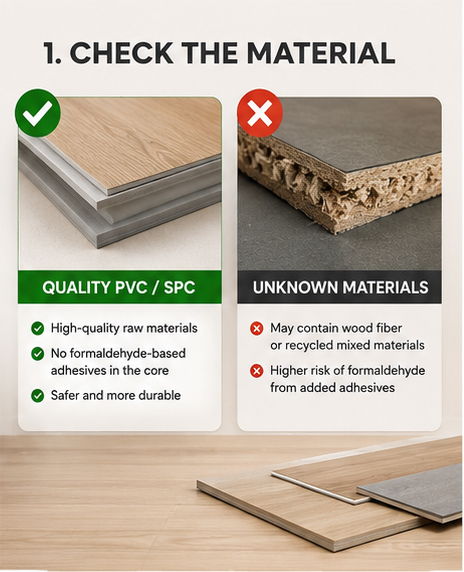
1. Verify the Core Material Composition
Premium SPC (Stone Plastic Composite) and PVC vinyl flooring are manufactured using inorganic mineral cores that do not require formaldehyde-containing resins or adhesives during production. This makes them inherently low-emission products. Conversely, be highly cautious of budget flooring constructed from unverified recycled plastics, mixed waste materials, or unknown composites. These materials often lack quality control and may introduce unstable chemical compounds into your indoor environment. Always request a detailed material breakdown from the supplier to ensure the product meets your project’s health and safety standards.
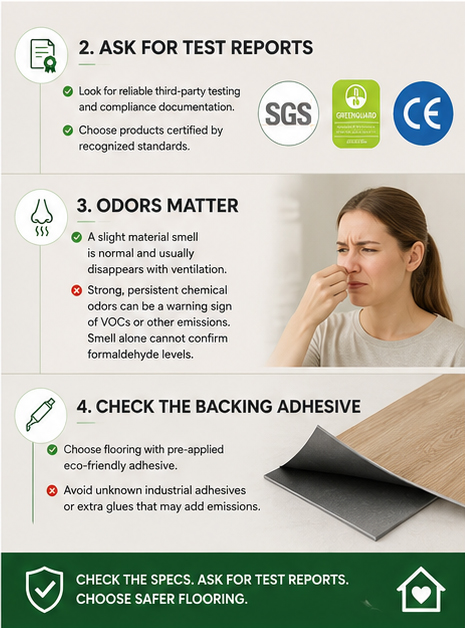
2. Demand Third-Party Test Reports and Compliance Documentation
Never rely on vague marketing terms such as “green,” “non-toxic,” or “eco-friendly” as proof of safety. These terms are often unregulated and can be misleading. A reputable manufacturer will readily provide verifiable third-party laboratory test reports. Look for certifications that confirm compliance with international standards for volatile organic compounds (VOCs) and formaldehyde emissions, such as FloorScore, GREENGUARD Gold, or relevant ISO standards. If a supplier cannot produce these documents upon request, it is a significant red flag regarding the product’s quality and safety.
3. Assess Physical Odors with Informed Caution
While a strong, persistent chemical odor is often an immediate indicator of high VOC emissions, it is crucial to understand that the human nose has limitations. The absence of a strong smell does not guarantee low formaldehyde levels, as formaldehyde is only detectable by scent at concentrations higher than typical safety thresholds. However, if a sample emits a sharp, irritating, or lingering chemical smell, it is a clear warning sign of unstable materials or excessive chemical additives. Use odor as an initial screening tool, but always rely on certified test data for a definitive assessment.
4. Evaluate the Adhesive Layer and Installation Materials
In flooring systems, the adhesive layer—whether pre-attached to the plank or used during installation—can contribute more to indoor air pollution than the flooring core itself. Many low-cost options utilize industrial-grade or unidentified adhesives that continuously off-gas harmful chemicals. When selecting flooring, ensure the product uses high-quality, low-VOC adhesives. For glue-down installations, always specify compliant, low-emission installation adhesives and avoid generic, unlabeled industrial products. Transparency regarding the chemical composition of these layers is non-negotiable for maintaining healthy indoor air quality.
The Golden Rule for Flooring Procurement
The most reliable strategy for purchasing affordable flooring is to prioritize transparency and data over marketing claims. Always review the technical specifications, insist on up-to-date third-party test reports, and partner with suppliers who are transparent about their materials and safety compliance. By taking these steps, you can achieve significant cost savings without compromising the health, safety, and longevity of your flooring investment.